
UIST2023 Generative Agents: Interactive Simulacra of Human Behavior
Published:
A detailed review of the UIST 2023 paper “Generative Agents: Interactive Simulacra of Human Behavior,” analyzing its memory-reflection architecture for believable agent simulation.
1. Recap
- We have been discussing emerging knowledge and how we are curious about the process the multi-agent system uses to emerge language representation during satisfying its communication needs.
2. What is this paper all about, and what makes it special?
- The paper explores generative agents, which are computational agents capable of simulating believable human behavior. These agents act in dynamic, interactive environments, adapting their behaviors based on past experiences (memories), reflections, and real-time changes in the environment.
- What makes the paper special is its novel architecture that combines large language models with memory systems to generate coherent, context-sensitive, and emergent behaviors over time.
- This is a step forward in creating agents that behave like human-like entities in various interactive applications, such as games or social simulations.
3. Observations in this paper, are there things we may be interested in?
- This paper’s focus on emergent social behavior, memory retrieval, and reflection-based planning could align with our interest in understanding how multi-agent systems develop their own language representations.
- The agents in the study demonstrate how interactions can lead to emergent group behaviors, which may provide insights into communication needs in multi-agent systems.
4. What is the good engineering practice in this paper?
- After reviewing the source code of this paper, it is an integration of lots of engineering practices, but most of them, like the history management system, are kinda old from today’s perspective.
- For example, no vector database means high precision and high token cost but lacks the ability to generate long history.
- It doesn’t use the latest tools call functions, which is a more mature implementation in enum reply and action call, etc., making the framework outdated compared to today’s common way of defining questions or prompts.
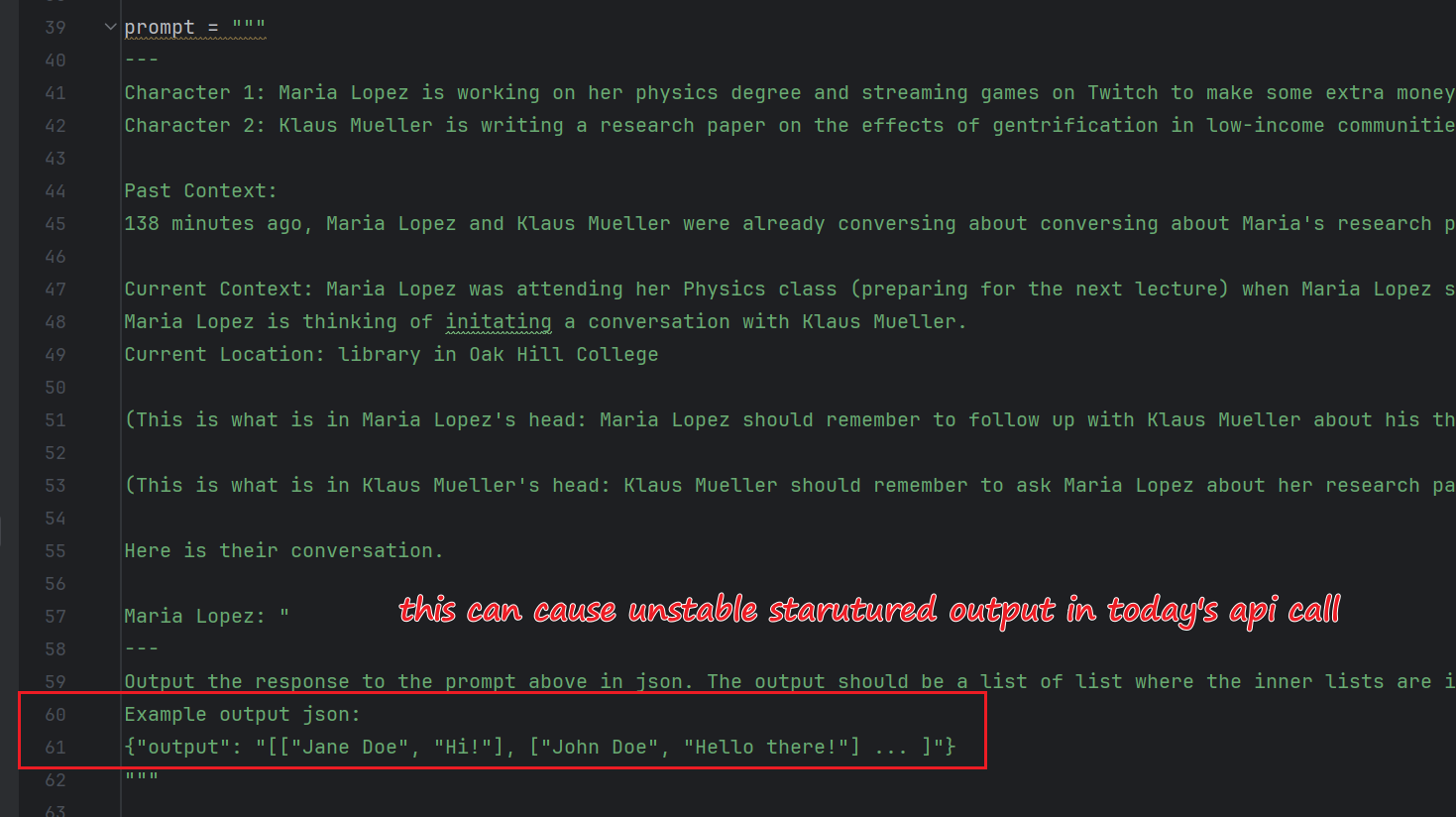 In real deployment of the simulation, it easily goes to error, say the return list with length 0.
5. To what extent can this paper contribute to our task?
- Based on our observations, the architecture of memory, reflection, and dynamic decision-making could offer some insights into how we might design a system to encourage emergent knowledge in multi-agent setups. The reflection-based behaviors, in particular, could be adapted to help agents form and refine their language representations over time as they interact.
6. Summary
- The paper presents a novel approach to simulating human-like behaviors in computational agents by integrating large language models, memory systems, and reflection-based planning. While the engineering practices are somewhat dated, the overall framework offers valuable insights into how agents can autonomously learn and adapt, which could be useful in our multi-agent research.
7. End note
- This paper provides a foundational architecture for exploring multi-agent communication and emergent behaviors, but there are opportunities to improve upon its engineering implementation using modern tools like vector databases and function calls to make it more scalable and efficient for handling long-term, complex interactions.
🍀Afterword🍀 The blog focuses on programming, algorithms, robotics, artificial intelligence, mathematics, etc., with a continuous output of high quality. 🌸Chat QQ Group: Rabbit’s Magic Workshop (942848525) ⭐Bilibili Account: 白拾ShiroX (Active in the knowledge and animation zones) ✨GitHub Page: YangSierCode000 (Engineering files) ⛳Discord Community: AierLab (Artificial Intelligence community)